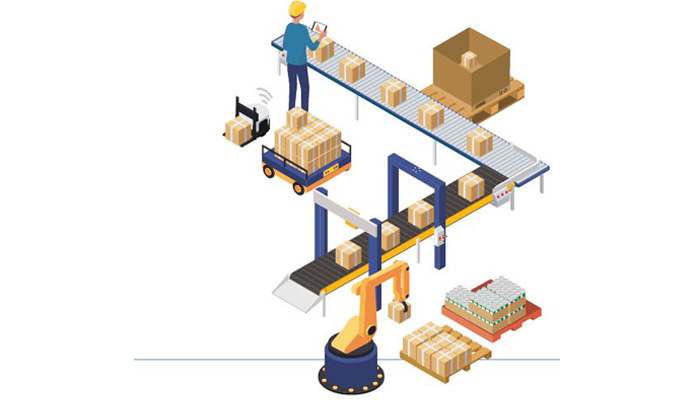
In a recent Business Intelligence report titled “End of Line Equipment: Purchasing Trends and Design Insights,” PMMI reviews the current trends in packaging and how they affect end-of-line (EoL) equipment functionality features. Packaging industry trends include the increased demand for sustainable packaging, lines running an increased number of SKUs, navigating labor shortages, increased supply chain visibility, and supply chain shortages. With these concerns, manufacturers must be aware of the features and capabilities of end of line packaging equipment & turnkey packaging machinery to meet these trends and the next generation of packaging trends.
End-of-Line Processing and Packaging Solution Features:
- Fast Changeovers: EoL equipment must have fast and easy changeovers to accommodate varying packaging formats such as the wrapping material, EoAT handling needs, etc. Quick changeovers are thus extremely important in keeping the packaging line throughput high. A Technical Supervisor for a leader in personal care products told PMMI, “Most lines run five to ten different sizes so new equipment should be agile, requiring no tooling to make adjustments that are preset to reference points.”
- Adaptability: Manufacturers are running an increased number of SKUs on their packaging line and because of this, EoL machines need to handle products and packaging that have different sizes, weights, materials, strength tolerances, and more. According to the report, 42% of companies they interviewed stated they are feeding multiple production lines into one EoL packaging line. With all these variances of products, EoL equipment must be versatile enough to be able to handle these different products easily without compromising the productivity levels while not compromising the integrity of the products.
- Modular and Mobile: EoL equipment must be modular and mobile enough to seamlessly integrate into existing lines, accommodate any space constraints and production schedules. As one Robotics and Automation Manager at a large dairy foods processor noted to PMMI, “To use our space more efficiently, we work with OEMs to preplan equipment designs to be more modular and mobile.”
- Intuitive Interfaces: Many companies in the industry are affected by labor shortages, so manufacturers should look for EoL machinery that has intuitive interfaces so a wide range of employees can operate the machine without a deep knowledge of the equipment. Operations can maintain at high levels when the machines are easily adjustable by a range of skilled or unskilled labor.
- Digital Intelligence: When EoL machinery has monitoring software enabled, manufacturers can observe the efficiencies and inefficiencies of the equipment and adjust on a by-need basis. As an Engineering Project Manager of a leading prescription drug company told PMMI, “More preventative monitoring is needed on equipment to coordinate along the entire line, reduce downtime, and minimize unscheduled maintenance costs.” An Engineer Manager at a large household product company noted, “The biggest impact smart technology will have on our business will be remote monitoring for machine troubleshooting.”
- Integration and Connectivity: As multiple product lines are fed to the end of line, not only is it important for all the packaging machines to run at optimal speeds but especially for the EoL which is handling this range of products sizes. When output goals are high, the line must be running at peak speeds and integration between all of the packaging equipment is necessary for seamless performance. EoL machines now come with built-in machine sensors that can integrate into an ERP system and collect additional data. According to the report, 62% of companies interviewed cited the digital transfer of data across their operations as a key feature in their product planning that will have the biggest impact on operational efficiency in the future. A Technical Supervisor at a leader in personal products company told PMMI, “We are using AI on one line and it will have the greatest impact on operations in the future.”
The modern production landscape demands a departure from “standard” configurations, as the sheer variety of packaging types, from flexible pouches and heavy-duty jugs to delicate glass jars, requires highly customized end-of-line solutions. A robust system must do more than simply close a box, it must master a range of functionalities including case erecting, robotic palletizing, and precision labeling. The goal is a seamless transition from the primary package to the shipping container, ensuring that structural integrity is maintained regardless of the substrate or weight.
Current industry trends are heavily influencing these mechanical choices, with a massive shift toward sustainability and labor-resilience. Manufacturers are increasingly seeking machinery that can handle thinner, recycled corrugated materials without jamming, alongside intuitive interfaces that reduce the learning curve for new operators. The rise of omnichannel distribution means end-of-line packaging machines must be flexible enough to switch between retail-ready displays and standard shipping cases with minimal downtime. By prioritizing modularity and smart data integration, ProMach solutions allow brands to stay agile, turning the end of the line from a potential bottleneck into a strategic competitive advantage.
With all this new technology it’s important for both manufacturers purchasing EoL equipment and OEMs to stay on track of trends that affect packaging lines. A great example of how an EoL that features the technologies and capabilities mentioned above can transform a packaging line is this new video featuring Snak King, where ProMach product brands Brenton and Quest help bring the packaging line automation to the next level.
2021. End of Line Equipment: Purchasing Trends and Design Insights. [ebook] PMMI. Available at: <https://www.pmmi.org/report/2021-end-line-equipment-purchasing-trends-and-design-insights>