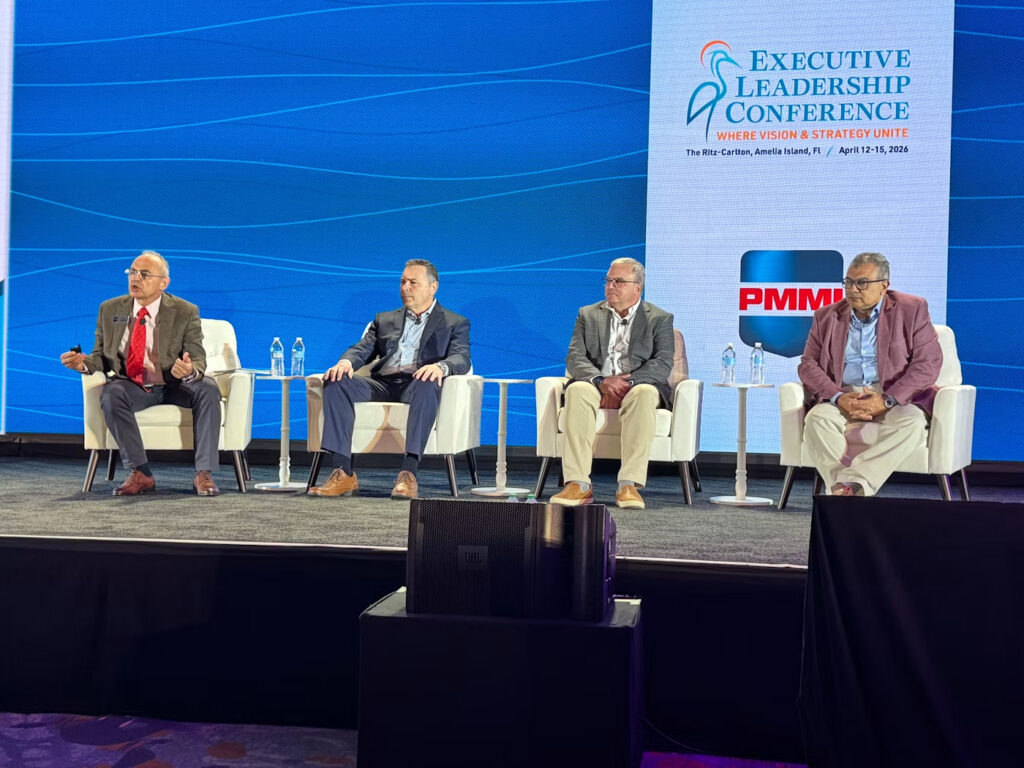
There’s a reason OEM Magazine keeps coming back to ProMach’s AI program. This is the second feature in less than a year — following a November 2025 piece on how ProMach built its in-house PAIRIS AI program. The theme across both: ProMach isn’t treating AI as a side experiment. It’s building an operating discipline around it — the same way it builds machines.
The latest installment came out of PMMI’s Executive Leadership Conference, where Rob Cartia, ProMach’s VP of Business Process, joined leaders from Microsoft and Spee-Dee Packaging Machinery to talk about what actually separates an AI pilot from an AI program that scales. Three lessons stood out.
1. Start where the value is obvious — not where it’s flashy.
ProMach’s AI program didn’t begin as a top-down directive. It started with grassroots experimentation — small teams using AI to speed up everyday work like documenting engineering procedures and getting faster answers to customer questions through tools like Salesforce Einstein. Those early wins built the case for something bigger: ProMach Artificial Intelligence for Resource Information and Solutions (PAIRIS), ProMach’s own internal AI platform, built to bring that same knowledge-capture and efficiency thinking to a company operating across more than 50 decentralized brands.
2. Governance isn’t a brake — it’s what lets you scale.
Managing AI across dozens of independently run brands raises real questions: what data can a tool see, which vendors can be trusted with it, and who signs off before a new use case goes live. This is where the PAIRIS AI program does its real work — ProMach built that structure in early rather than retrofitting it later — data protection and vendor scrutiny come before scale, not after. It’s a less exciting story than the tools themselves, but it’s the reason the program has been able to expand without losing control of it.
3. If you can’t tie it to financials, you can’t justify it.
Cartia was direct about what ultimately makes the case for continued investment: measurable business impact, not novelty.
“You have to tie it to financials,” Cartia said. “It’s very difficult to justify the investment if you can’t show what it means.”
That’s a discipline as much as a metric, as it means every new AI use case at ProMach has to answer a basic question before it earns a place in the program: what does this actually save, speed up, or improve, and can we prove it?
What the PAIRIS AI program proves
None of this reads like a typical AI story. There’s no moonshot, no single dramatic rollout — just the same deliberate, prove-it-first approach ProMach brings to building equipment, applied to how the company runs itself. That consistency is exactly why trade press keeps coming back to it.