Liquid food portfolios are growing faster than most plants were built to handle. One week it’s a thin vinaigrette, the next it’s a particulate-loaded salsa. And the line is expected to switch between them without losing speed, temperature control, or yield.
That kind of flexibility doesn’t come from swapping out one machine. It comes from treating the whole line — batching, thermal processing, and filling — as a single connected system. That’s the real difference between liquid food processing machinery that’s bought piece by piece, and a line engineered to run as one from day one.
Where Liquid Food Lines Actually Lose Time
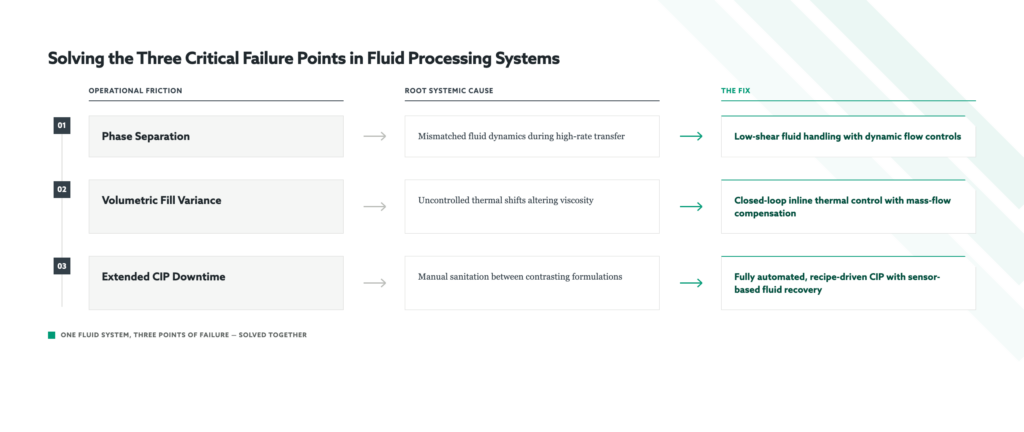
When overall equipment effectiveness (OEE) comes in lower than it should, it’s rarely one bad machine. Audit most liquid food lines and the real losses show up in three places:
- Shear Damage and Phase Separation: Mismatched transfer pumps can shear delicate liquid foods hard enough to break their structure, showing up later as separation on the shelf.
- Temperature Swings That Throw Off Every Fill: When hold-time temperatures drift, viscosity shifts mid-run — and fill weights drift right along with it, forcing constant manual correction at the filler.
- The Changeover Tax: Switching between very different products means longer flush cycles and a slower climb back to full speed. This is valuable time that adds up fast across a full production schedule.
None of these get solved by a better single machine. They’re solved by liquid food processing solutions designed to handle all three at once.
Buying Machines vs. Building a Line
Q: Why isn’t buying equipment machine-by-machine enough anymore for liquid food processors?
A: Every filler, cooker, and skid on a liquid food line affects every other one — backpressure, temperature loss, and communication lag between each machine’s PLC (its onboard controller) all ripple downstream. Bought and installed one at a time, those small mismatches turn into micro-stoppages and wasted product every time a line changes over.
Q: What does it actually look like to run the line as one unified system?
A: Fluid handling, thermal processing, and packaging all run under shared control logic, so synchronizing upstream batching talks directly to the filler instead of waiting in a holding tank. The payoff is steadier viscosity, faster changeovers, and a line that adapts across categories without starting from scratch. The result isn’t machines that happen to sit next to each other — it’s automated processing systems built to run as one line.
The Payoff: Speed and Quality, Not One or the Other
Growing a liquid food portfolio doesn’t mean choosing between speed and quality, especially not when processing, thermal control, and packaging are engineered to run as one line instead of a chain of separate machines. That’s exactly what liquid food packaging solutions built as one connected system are supposed to deliver: not speed instead of quality, but both, together.